

Introduction
Mathematics learning is complex. When a student experiences difficulty, an incorrect answer or a low score can tell us that something deserves attention, but it does not necessarily tell us why the difficulty is occurring or what the student needs next. Students may struggle with the same task for very different reasons, and effective instruction begins with understanding those differences.
This article introduces the Numeracy House Model, an evidence-informed framework that brings together established research and concepts in mathematics learning. The model considers mathematical content, a student’s stage of learning, cognitive abilities that may influence access to the task, and the student’s experience of mathematics. Rather than treating these elements in isolation, it organizes them within a single framework to help educators consider how they interact and make more precise instructional decisions.
The Same Answer, Different Needs
Imagine four students working on the same subtraction problem: 403 − 178. They all write the same incorrect answer.
At first glance, it is tempting to group them together. They got the same answer, so perhaps they need the same lesson. Then we sit beside them and ask, “Can you show me what you were thinking?”
The first student is unsure what the digits in 403 represent. The second understands hundreds, tens, and ones but has learned an unreliable rule: subtract the smaller digit from the larger one in each column. The third can explain the exchange and complete the procedure accurately, but every step takes considerable effort. The fourth solves similar questions successfully during a quiet conference but freezes when asked to work at the board.
The page told us that all four students were struggling. The conversation told us they were not struggling in the same way.
The third student is worth keeping in view. This student understands place value, can explain why an exchange preserves the value of the number, and can complete the subtraction accurately. Yet coordinating the written steps requires so much effort that performance is slow and sometimes inconsistent. As we move through the house, this student will help us see how each part changes the questions we ask.
This is the point at which good teaching becomes careful reasoning. What does the student already understand? Where did the thinking break down? Does the student need the idea explained, more supported practice, or help using it independently? Is anxiety getting in the way of showing what they know?
These questions are especially important when we support students with learning disabilities (LDs). Ontario’s definition of an LD includes difficulties in acquiring and using mathematical skills (Ontario Ministry of Education, 2014). An identification can help explain persistent difficulty. It does not tell us what to teach on Tuesday morning.
One way to slow this down is to think of mathematics as a house. As with reading, mathematics is not a single, unified ability but a collection of connected parts that students learn to bring together. The Numeracy House Model organizes that complexity so we can consider the mathematical content, the student’s stage of learning, the abilities supporting the work, and the student’s experience of mathematics. It gives us a way to ask what needs a closer look before deciding what to teach.
| In Your Classroom Think of a student whose mathematics work has raised a concern. Before deciding what the student needs, consider:What does the work sample actually tell you? What does it not tell you? What might you learn by asking the student to explain or represent their thinking in another way? |
A House for Thinking About Mathematics Learning
Picture the model as a house. It rests on a foundation, two instructional pillars hold it up, and a roof brings the structure together. Each part represents something students draw on as they learn mathematics. The parts can be considered separately when we are trying to understand a difficulty, but they work together during mathematical learning.
The foundation, Cognitive Abilities, represents a set of foundational supports for mathematics learning and helps us ask: What supporting abilities may be affecting the student’s mathematics learning? It includes five interacting areas: quantity and symbolic-number knowledge; mathematical language and comprehension; visual-spatial processing, representation, and reasoning; working memory; and attention and executive functions. Their contribution changes with the mathematical content, representation, task demands, prior knowledge, language, and instructional context.
That does not mean the foundation must be “finished” before real mathematics can begin. A student does not have to pass through a waiting room of prerequisite exercises before joining a meaningful place-value lesson. The abilities in the foundation can develop alongside mathematical knowledge. Representing 403 with materials, saying the number aloud, drawing it, and writing it in expanded form can support several parts of the house at once.
The first pillar, Mathematical Content, identifies what is being taught. There is no single internationally standardized list of mathematical content areas; curricula organize and name them differently. Nevertheless, major curriculum frameworks, including those used in Australia, England, Ontario, and the United States, recognize broadly comparable areas such as number and operations, including place value; algebra, relationships, and patterns; measurement; geometry and spatial reasoning; and statistics and probability (Australian Curriculum, Assessment and Reporting Authority, 2022; Department for Education, 2013; National Governors Association Center for Best Practices & Council of Chief State School Officers, 2010; Ontario Ministry of Education, 2020a). Within these areas, students develop interconnected concepts, facts, relationships, and procedures. This pillar helps us ask: What particular mathematical knowledge or skill is the student learning?
Locating the content is necessary, but it is not enough. A student may know that a question calls for subtraction without understanding the exchange in the written procedure. Another may understand the exchange with materials but not yet carry it out accurately on paper. We also need to know where the student is in learning that particular content.
The second pillar, the Instructional Hierarchy, describes the student’s current stage of learning a particular skill. It includes four stages: acquisition, fluency, generalization, and adaptation. A student who is developing initial understanding needs something different from a student who is accurate but effortful, or from one who can use a skill only when the question looks familiar. This pillar helps us ask: Where is the student in learning this particular content?
The stage belongs to the skill, not to the student as a whole. A student can be fluent with addition facts, acquiring a regrouping procedure, and adapting place-value knowledge during the same week. Learning is not strictly linear. New examples may reveal a misconception that needs to be revisited, and understanding can continue to deepen as performance becomes more fluent and flexible.
Ideas from Adding It Up, including understanding, procedural fluency, strategic problem solving, and reasoning, remain important (National Research Council, 2001). In the house, these ideas inform what we look for across the stages rather than becoming another framework educators must learn. Representation, explanation, strategy use, and justification may appear at every stage, although their form and independence change as learning develops.
The roof, Productive Disposition, helps us ask: How is the student experiencing and approaching mathematics? Productive Disposition includes seeing mathematics as something that makes sense and is worth doing, while believing that becoming more capable is possible. A roof may look like the final part of a house, but students do not wait until the end of learning to form beliefs about mathematics. Every invitation to explain, every public comparison, every useful piece of feedback, and every experience of progress can affect whether a student feels capable and included.
The value of the model is in seeing the parts together. A difficulty that first appears procedural may also involve place value, working memory, or the student’s experience of mathematics. The house helps us hold those possibilities in view before deciding what to do next.
Figure 1: House Model
The value of the model is in seeing the parts together. A difficulty that first appears procedural may also involve place value, working memory, or the student’s experience of mathematics. The house helps us hold those possibilities in view before deciding what to do next.
Figure 1: House Model
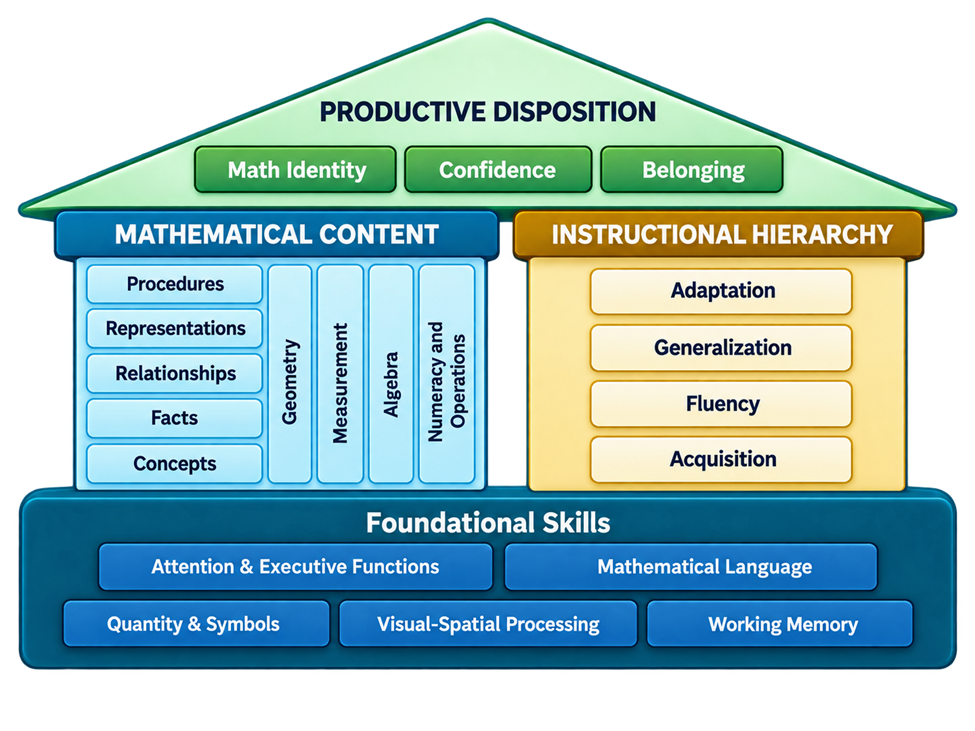
The Numeracy House Model organizes mathematics learning within a foundation, two interacting instructional pillars, and a roof. It helps educators consider the supporting cognitive abilities, the mathematical content being learned, the student’s stage within the Instructional Hierarchy, and the student’s Productive Disposition.
| Using the House: Four Questions to Ask When a student experiences difficulty in mathematics, consider:Cognitive Abilities: What demands of the task may be affecting access to the mathematics?Mathematical Content: What specific concept, relationship, representation, fact, or procedure is the student learning?Instructional Hierarchy: Where is the student in learning this particular skill?Productive Disposition: How is the student experiencing and approaching the mathematics?No single question provides the whole answer. The value comes from considering them together. |
Foundations for Mathematical Learning
The foundation contains interacting supports for mathematical learning. Their importance changes with the content, representation, language, and demands of the task. A number line estimate, a geometric transformation, and a word problem do not draw on these abilities in exactly the same way.
These supports are not a readiness gate. Cognitive abilities support mathematical learning, while growing knowledge and increasingly fluent strategies can reduce the demands a task places on those abilities.
Quantity and Symbolic-Number Knowledge
Long before children can read a numeral, they notice quantity. They can see that one group contains more than another, that something has been added, or that one amount is much larger than another. This early sensitivity is one starting point for mathematical learning.
Consider what a child must bring together to understand the number five. The child needs to recognize five objects as a quantity, connect that quantity to the spoken word five, and connect both to the written numeral 5. Over time, five becomes part of an ordered system. It comes after four and before six, is less than seven, and can be composed and decomposed in different ways. Learning a number is much more than learning the name of a symbol.
Research associated with Daniel Ansari shows why these connections matter. Symbolic and nonsymbolic quantity knowledge are related, but they are not the same, and development may work in both directions. Experiences with quantities can give symbols meaning, while learning number words and numerals can change how children think about quantities (Lyons & Ansari, 2015). Once formal mathematics begins, knowledge of number words and numerals is more consistently associated with achievement than performance on isolated dot-comparison tasks. Numerical-symbol knowledge includes identifying a numeral, connecting it to an exact quantity, and understanding its place in an ordered system (Holloway & Ansari, 2009; Merkley & Ansari, 2016).
Students continue to connect numbers with number lines, place value, operations, and more complex relationships. When these connections are insecure, numbers can feel like arbitrary marks and rules. Instruction can make the links among quantities, words, numerals, order, number lines, and operations explicit rather than treating “number sense” as one isolated ability (Geary, 2011).
Mathematical Language and Comprehension
Show students the + sign and ask how many words might surround it. We might say add, plus, sum, total, altogether, combined, in all, or increased by. None should become a shortcut for choosing an operation. Students still need to understand the mathematical relationship.
Now think again about five. It can appear as five fingers, five dots, five dollars, five o’clock, a position on a number line, the numeral 5, the Roman numeral V, or 101 in binary notation. It might be the value of an unknown, a coordinate, part of a fraction, or one factor in a multiplication. The quantity remains connected while its representation and surrounding language change.
Mathematical language therefore carries concepts, quantities, relationships, and procedures, not simply vocabulary. Understanding equal means recognizing that two expressions have the same value. Understanding three fewer than requires a comparison between quantities. Directions such as exchange one ten for ten ones must connect words with an action that preserves quantity. Mathematics-specific language and performance are moderately associated, but this relationship does not show that language difficulty causes mathematical difficulty or that vocabulary teaching alone will improve mathematics (Zhu et al., 2026).
We must also distinguish mathematical language from decoding the printed words in a task. A student may understand a relationship when it is explained orally or represented in a diagram but have difficulty reading the same word problem. That may point toward reading demands. The question here is whether the student understands the mathematical meanings carried by the language, however it is presented. Research on word problems supports considering mathematical knowledge, language comprehension, and working memory together rather than reducing performance to any one of them (Wang et al., 2016).
Visual-Spatial Processing, Representation, and Reasoning
Picture where 37 belongs on a number line, how ten ones can be reorganized as one ten, or what a shape will look like after it rotates. Visual-spatial processing helps students form and change these mental representations. It also supports their use of external representations such as diagrams, place-value models, geometric figures, graphs, and part-whole models.
A student may understand the words in a geometry problem but have difficulty imagining the transformation. Another may lose track of how parts of a diagram relate to the whole. One observation cannot establish a visual-spatial weakness. It offers a possibility to explore and a reason to see whether a clear diagram, aligned columns, concrete materials, or a better organized page makes the mathematics more accessible.
Isolated visual-spatial training is not an established intervention for mathematics learning disabilities. A review found small average transfer to mathematics, with stronger effects when the spatial activity closely resembled the mathematics being measured (Hawes et al., 2022). Direct mathematics instruction should continue while representations are used to clarify relationships and unnecessary visual demands are reduced.
Working Memory
Working memory is the ability to hold information in mind while working with it. During 403 − 178, the student we have been following must keep track of the original quantities, coordinate an exchange, hold intermediate values, and decide what comes next. Because the student understands place value and can explain the exchange, working memory is one reasonable instructional hypothesis for why accurate execution remains effortful. It is not a diagnosis.
Across 110 studies, working memory and mathematics were moderately associated, although working memory explained only a minority of the variation in performance (Peng et al., 2016). It also overlaps with attention and other executive functions, and longitudinal associations do not establish that working memory causes mathematical difficulty (Spiegel et al., 2021; Tette et al., 2026).
The student’s response to support can tell us more. Keeping intermediate values and steps visible reduces what must be held mentally. Worked examples, organized representations, and carefully planned practice can help the procedure become accurate and less effortful. As familiar steps become more automatic, they require less attention, leaving more mental space for reasoning. Automaticity can free attention without making speed the goal.
Research has not shown dependable long-term transfer from isolated working-memory training to stronger mathematics. The more useful response is to teach the mathematical skill directly while adjusting memory demands so the student can engage with it.
Attention and Executive Functions
Attention influences both what students learn during instruction and how consistently they carry out mathematics they already know. Missed explanations can leave gaps because later mathematics often builds on earlier ideas. During a multistep task, a brief lapse may lead a student to skip an operation, misalign place value columns, copy a number incorrectly, or lose their location in the procedure.
These are often called “careless errors,” but that description can be unfair and unhelpful. The student may understand the concept and know the procedure while having difficulty sustaining attention across its details. Attention may also change with anxiety, fatigue, distraction, time pressure, or the testing environment.
Working memory, attention, inhibitory control, and cognitive flexibility overlap. They can help a student maintain a goal, ignore irrelevant information, monitor a strategy, and change course when needed. Research finds associations with mathematics, but the pattern varies across tasks and students and does not identify one executive function profile shared by students with mathematical difficulties (Agostini et al., 2022; Spiegel et al., 2021; Tette et al., 2026).
Making the goal and steps visible, marking the current line or operation, breaking longer tasks into sections, and checking signs or copied values may help. If performance improves, that evidence informs teaching. It does not confirm an attention difficulty. Classroom observations support an instructional hypothesis, not an informal diagnosis.
What Is Not Part of the Foundation: Processing Speed
Mathematical efficiency is not processing speed. General cognitive processing speed concerns how quickly relatively simple mental operations can be completed. Mathematical efficiency develops as students understand relationships, organize effective strategies, retrieve learned facts and procedures, and gain fluency through instruction and practice.
Some studies report processing speed differences among students with mathematical difficulties, but the findings depend heavily on what is timed, how difficulty is defined, whether reading difficulty is controlled, and whether a task contains numerical material. Differences appear more consistently on complex tasks involving visual search, coding, or rapid naming than on simple reaction time tasks. Under stricter clinical criteria and stronger reading controls, evidence for a broad speed difference is limited (Agostini et al., 2022; Haberstroh & Schulte-Körne, 2022; Peng et al., 2018).
A timed mathematics worksheet is not a pure measure of processing speed. Slow performance may reflect incomplete knowledge, an effortful strategy, limited retrieval, unfamiliar symbols, language, visual search, attention, anxiety, motor demands, limited practice, or a preference for accuracy. The more instructionally useful question is not, “Does this student have slow processing speed?” but, “Which mathematical knowledge, relationships, strategies, or retrieval processes are not yet sufficiently understood, organized, or fluent?”
Reducing the demands around the subtraction procedure may help this student show what they know. Yet an important question remains unanswered: what, precisely, is the mathematical learning target?
| From Observation to Instruction A classroom observation can suggest a question to explore, but it does not diagnose a cognitive weakness.Instead of asking:“Does this student have a working-memory problem?”consider asking:“What happens when I reduce the amount the student needs to hold in mind while keeping the mathematical goal the same?”Changes in student performance can help inform the next instructional decision. |
Looking Inside Mathematical Content
Suppose we say that a student is having difficulty with geometry. What have we actually learned? Not very much yet. Geometry is not one piece of knowledge that a student either has or does not have. A student may recognize familiar shapes but rely on how they look rather than their defining properties. They may describe the properties of a rectangle but have difficulty composing or decomposing shapes. They may understand position and direction but not yet understand transformations, coordinates, angles, congruence, or similarity. Each of these involves additional concepts, relationships, representations, language, and procedures that need to be learned and connected.
The same is true across mathematics. Number and operations includes knowledge of quantity, counting, numeral meanings, magnitude, place value, arithmetic relationships, fractions, decimals, and operations. Algebra develops from noticing and describing patterns and relationships toward understanding equality, unknowns, expressions, equations, proportional relationships, and functions. Measurement includes comparing attributes, understanding units, using instruments, iterating and converting units, and reasoning about scale and precision. Statistics and probability includes asking questions, collecting and representing data, interpreting distributions, and reasoning about likelihood and uncertainty. Each content area therefore contains connected knowledge that develops and becomes more sophisticated over time.
This way of dividing mathematical knowledge is not unique to the Numeracy House Model. Major curricula give these areas different names and organize them in different ways. Australia uses Number, Algebra, Measurement, Space, Statistics, and Probability. England changes its organization as students move through the curriculum and gives areas such as ratio and proportion their own place. Ontario brings geometry and measurement together within Spatial Sense and includes Financial Literacy as a separate strand. The Common Core reorganizes its domains across the grades as early counting, operations, and base ten knowledge develop toward fractions, algebra, functions, geometry, and statistics and probability. These frameworks are not identical, and none provides an international master list. They do, however, show broad agreement that mathematical content includes several distinguishable, connected areas that become more sophisticated over time (Australian Curriculum, Assessment and Reporting Authority, 2022; Department for Education, 2013; National Governors Association Center for Best Practices & Council of Chief State School Officers, 2010; Ontario Ministry of Education, 2020a).
Curricula identify the broad territories of mathematics; learning progressions help us look more closely at how knowledge develops within them. Within each area, new learning often draws on knowledge developed earlier. Consider measurement. Before a student can measure a desk accurately with centimetres, they need to understand what attribute is being measured, that the units must be equal, and that those units must be placed without gaps or overlaps. Research with kindergarten students found that instruction organized through an informed sequence of length measurement ideas produced stronger learning than teaching the same ideas in reverse order (Sarama et al., 2021). More broadly, research on mathematical learning trajectories suggests that common progressions can help us anticipate the intermediate understandings that may support later learning (Clements & Sarama, 2025).
These progressions are guides, not fixed sequences. Students do not all develop in exactly the same way, and an earlier idea does not always need to be completely mastered before a student can encounter meaningful later content. Concepts, procedures, and representations can develop together and strengthen one another as students revisit an idea in new ways (Rittle-Johnson, 2017). A progression helps us ask what knowledge might make the current learning more accessible. It should not become a reason to hold a student indefinitely at an earlier grade level.
Earlier knowledge can also support learning across content areas and many years of development. Early whole number magnitude knowledge has been found to predict later fraction magnitude knowledge, while early whole number arithmetic predicted later fraction arithmetic (Bailey et al., 2014). Knowledge of fractions and division in elementary school has also predicted later algebra achievement (Siegler et al., 2012). These longitudinal findings do not prove that mathematics develops through one universal causal sequence. They do show why incomplete earlier knowledge can continue to matter when a student meets more complex ideas.
Students will not necessarily develop equally across all of these areas. Research with young children has identified distinguishable dimensions of knowledge in number and operations, measurement, geometry, and patterning (Milburn et al., 2019). Research with Grade 4 achievement data has also found groups of students whose difficulty with geometry was greater than their difficulty with number or data (Chen et al., 2021). One student may interpret graphs and data capably but struggle to see the relationships in fractions. Another may notice algebraic patterns while finding geometric properties difficult to organize. A single total mathematics score can hide these differences.
When we find a gap, we still need to be careful about the story we attach to it. The student may have missed instruction, changed schools, had fewer opportunities to work with the idea, learned a procedure without its underlying relationships, or experienced teaching that did not make the content accessible. Interrupted educational opportunities have been associated with larger learning losses in mathematics than in reading at the population level, although that evidence cannot explain the needs of one student (Betthäuser et al., 2023). A gap may also be persistent and part of a mathematics learning difficulty. The gap itself does not tell us its cause, and it does not mean that the student is weak across mathematics.
Look at what this precision changes in the opening example. The broad content area is number and operations, but “subtraction” is still too general. The student can represent 403, explain the value of its digits, and show why exchanging one hundred for ten tens preserves the quantity. The learning target is the reliable, increasingly fluent execution of a written subtraction procedure that involves exchanges. We can identify that target only because we separated what the student understands from what remains effortful.
The Mathematical Content pillar asks us to move beyond “This student struggles with geometry” or “This student is behind in math.” We look inside the broad area. Which concepts, facts, relationships, representations, and procedures are already connected? Which connection is still developing? What particular mathematical knowledge or skill is the student learning? Only then can we interpret the student’s stage of learning that skill.
Looking More Closely at the Stages
The student can explain and complete the subtraction procedure, but each exchange still requires deliberate attention. This particular skill is moving from acquisition into fluency. That does not place the student at one overall stage of mathematics learning.
During acquisition, the student is developing an initial understanding and learning to perform the skill accurately. We might look for whether the student can represent the mathematical idea, explain an important relationship, connect a representation with symbols or a procedure, distinguish correct from incorrect examples, and complete the task with decreasing reliance on prompts. Conceptual understanding is not limited to acquisition, but it is especially important when we are deciding whether an error reflects a misconception or an incompletely learned procedure.
During fluency, performance becomes more accurate, efficient, independent, stable, and appropriately flexible. Fluency is not a race. Automaticity, doing something accurately with little mental effort, is one part of fluency and is recognized in Ontario’s mathematics curriculum (Ontario Ministry of Education, 2020a). When a familiar part of a task requires less attention, the student has more mental space for the larger problem. A brief timed sample may offer some information, but speed alone cannot establish fluency. Accuracy, strategy, effort, explanation, and classroom performance also matter.
During generalization of a particular skill, the student recognizes and uses the learning when examples, representations, vocabulary, question formats, settings, or problem types change. A student may subtract accurately on a page of calculations but not recognize subtraction in a comparison problem. Varied examples and contexts help the student notice the relationship beneath the surface.
During adaptation of that skill, the student uses the learning in less familiar situations. They may select or modify a strategy, combine knowledge from different areas, compare possible approaches, justify a decision, or change course when the first approach does not fit. This is flexible mathematical reasoning in action, but reasoning and strategy use are not saved for the final stage. Students reason as they acquire a concept, explain as they build fluency, and make strategic choices during generalization too.
For this student, returning to the beginning of place value instruction would overlook demonstrated understanding. Speed practice alone would also miss the point. The student needs meaningful supported practice with the written procedure, with enough structure to keep the exchanges and intermediate values visible while accuracy becomes more stable and the work less effortful. Research supports matching mathematics instruction to the student’s current stage with the particular skill (Burns et al., 2010).
The stage belongs to the skill, not to the student as a whole. During the same week, this student might be fluent with addition facts, acquiring a regrouping procedure, generalizing fraction equivalence across representations, and adapting place value knowledge to explain a new problem. Learning is not strictly linear. A new example may reveal a misconception that needs attention, and understanding can continue to deepen while performance becomes more fluent and flexible.
LD@school’s article on mathematics fact fluency explores the Instructional Hierarchy and related classroom practices in more depth (Shkilnyk, 2025).
| A Stage Describes the Skill, Not the Student When using the Instructional Hierarchy, begin by identifying the particular mathematical skill you are considering. A student may be at very different stages with different skills, even within the same lesson or week.Students can reason, explain, represent, investigate, and solve meaningful problems throughout these stages. |
The Student’s Experience of Mathematics
Students do not experience instruction as a neutral sequence of lessons. They notice who is called “good at math,” whose strategies are taken seriously, whether mistakes lead to support or embarrassment, and whether their own effort results in visible progress.
Over time, these moments can shape a student’s mathematics identity. Identity is not simply confidence. It includes whether students see mathematics as something “for people like me,” whether others recognize them as capable, and whether they feel that their ideas belong in the room (Gulemetova et al., 2022). Repeated difficulty can become part of how a student describes themselves: “I’m just not a math person.”
A few plain-language distinctions help. Anxiety concerns how mathematics feels. Self-efficacy concerns whether a student believes they can manage a particular task. Identity concerns whether the student sees themselves as someone who belongs in mathematics. These experiences are related to skill, but none is a substitute for looking closely at what the student knows.
Research consistently links higher mathematics anxiety with lower performance, but this does not prove a simple cause (Namkung et al., 2019). Longitudinal research suggests influence may run in both directions: earlier achievement can predict later anxiety, and earlier anxiety can predict later achievement (Szczygieł et al., 2024).
Skill and anxiety can also come apart. In one study, children with developmental dyscalculia, a term sometimes used for LDs affecting mathematics, were more likely to report high anxiety, yet most highly anxious children performed within the typical range (Devine et al., 2018). Canadian students with mathematics difficulties have also reported more mathematics-specific anxiety than their peers (Vieira et al., 2026). We therefore need to ask about performance and experience separately.
The student may notice that classmates finish the subtraction page quickly while they are still coordinating the first few exchanges. If that comparison happens repeatedly, or if the student is asked to perform publicly before the procedure is secure, an effortful skill can begin to feel like evidence that they do not belong in mathematics. We cannot assume that anxiety caused the original difficulty. We can recognize that repeated effort and public comparison may shape the student’s self-efficacy and willingness to persist.
Success on a well-chosen challenge, paired with useful feedback, can strengthen a student’s belief that a similar task is manageable (Street et al., 2024). Research also suggests that both skill-focused and emotion-focused supports can reduce mathematics anxiety, although current evidence does not establish one approach as best for every student (Codding et al., 2023; Sammallahti et al., 2023).
The practical principle is to build competence and belonging together. Give students work they can enter without removing the mathematical goal. Make progress visible. Invite different ways of representing and explaining thinking. Useful feedback might name both understanding and growth: “You kept the value the same when you exchanged one hundred for ten tens, and you recorded each step accurately.” Students should not have to be fast or error-free before their ideas are heard.
| Consider the Student’s Experience Alongside what the student knows, consider:When does the student appear most willing to participate? Does performance change when the student is asked to respond publicly? What does the student say about themselves as a mathematics learner? Are speed or comparison with peers affecting confidence? How can feedback make progress and mathematical thinking visible? |
Gathering Evidence Across the House
The original incorrect answer told us only that something had gone wrong. Conversation and observation have now produced a more useful picture. The student understands the quantities in 403, can represent place value, and can explain why an exchange preserves the total value. When given time, the student completes the written subtraction procedure accurately. These observations make a fundamental place value misconception less likely.
We have also seen that coordinating exchanges and intermediate values requires considerable effort. Keeping the steps visible may reduce that effort, which makes working memory demands a reasonable instructional hypothesis. It does not diagnose a working memory weakness. The identified content target is reliable execution of the written procedure, and the student appears to be moving from acquisition toward fluency with that particular skill. None of this tells us that the student occupies a general fluency stage in mathematics.
The roof adds evidence that the page cannot show. We would want to know how the student experiences repeated effort, whether comparison with faster classmates affects self-efficacy, and whether public performance changes what the student can demonstrate. Anxiety, self-efficacy, and identity should not be used as substitutes for evidence of mathematical knowledge, but they matter to how the student approaches the work.
Some uncertainty remains. Attention, the design of the page, the amount of prior practice, and the familiarity of the example may all influence performance. We learn more by changing one demand, offering a related problem, and observing the response than by assigning a label from the first error. The house brings these sources of evidence together without pretending that any one observation explains the student.
Conclusion: What the House Helps Us See
For this student, the next step is probably not to reteach subtraction from the beginning. The student has shown an understanding of place value and exchange. The evidence points instead toward meaningful supported practice that keeps the written steps visible, protects accuracy, and helps the procedure become more fluent without turning speed into the goal. That practice should also make progress visible so effort is connected with growing competence rather than public comparison.
An incorrect answer is a beginning, not a conclusion. It tells us to pay attention. The Numeracy House helps us decide what deserves closer examination: the mathematical knowledge involved, the student’s stage in learning that particular skill, the abilities supporting the work, and the student’s experience of mathematics. The same written answer that first looked ambiguous can become the beginning of a focused instructional response.
The model has important boundaries. It does not claim that mathematics follows one rigid causal order. The foundation is not a gate that students must pass through, and Productive Disposition does not wait until the pillars are complete. A classroom observation does not diagnose a cognitive weakness. A student is never assigned one global Instructional Hierarchy stage. The parts interact, and the pattern can change from one skill and situation to another.
Once we have this more precise understanding, we can decide how to organize instruction, how much support to provide, and how to evaluate whether it is working. The companion article, From Understanding to Action: Using the Numeracy House Model in a Tiered Approach, takes up those decisions.
About the Author

Dr. Todd Cunningham is a clinical and school psychologist, Associate Professor, and Chair of the School and Clinical Child Psychology program at the University of Toronto. His research investigates supports for students with learning difficulties, from assessment through intervention. His projects include new approaches to psychological assessment, evaluation of assistive technology, professional development in literacy and numeracy, and telepsychology.
Related Resources
-
- The Ontario Curriculum, Grades 1–8: Mathematics: Current elementary curriculum expectations and contextual guidance.
-
- An Introduction to the Science of Math: LD@school overview of evidence-informed mathematics instruction.
-
- The Importance of Math Fact Fluency: LD@school discussion of the Instructional Hierarchy and classroom fluency practices.
-
- Dynamic Communities of Math Learners: LD@school resource on mathematics well-being and anxiety.
References
Agostini, F., Zoccolotti, P., & Casagrande, M. (2022). Domain-general cognitive skills in children with mathematical difficulties and dyscalculia: A systematic review of the literature. Brain Sciences, 12(2), Article 239. https://doi.org/10.3390/brainsci12020239
Australian Curriculum, Assessment and Reporting Authority. (2022). Australian Curriculum: Mathematics (Version 9.0). https://www.australiancurriculum.edu.au/curriculum-information/understand-this-learning-area/mathematics
Bailey, D. H., Siegler, R. S., & Geary, D. C. (2014). Early predictors of middle school fraction knowledge. Developmental Science, 17(5), 775–785. https://doi.org/10.1111/desc.12155
Betthäuser, B. A., Bach-Mortensen, A. M., & Engzell, P. (2023). A systematic review and meta-analysis of the evidence on learning during the COVID-19 pandemic. Nature Human Behaviour, 7, 375–385. https://doi.org/10.1038/s41562-022-01506-4
Burns, M. K., Codding, R. S., Boice, C. H., & Lukito, G. (2010). Meta-analysis of acquisition and fluency math interventions with instructional and frustration level skills: Evidence for a skill-by-treatment interaction. School Psychology Review, 39(1), 69–83. https://doi.org/10.1080/02796015.2010.12087791
Chen, J., Li, L., & Zhang, D. (2021). Students with specific difficulties in geometry: Exploring the TIMSS 2011 data with plausible values and latent profile analysis. Learning Disability Quarterly, 44(1), 11–22. https://doi.org/10.1177/0731948720905099
Clements, D. H., & Sarama, J. (2025). Systematic review of learning trajectories in early mathematics. ZDM–Mathematics Education, 57(4), 637–650. https://doi.org/10.1007/s11858-024-01644-1
Codding, R. S., Goodridge, A. E., Hill, E., Kromminga, K. R., Chehayeb, R., Volpe, R. J., & Scheman, N. (2023). Meta-analysis of skill-based and therapeutic interventions to address math anxiety. Journal of School Psychology, 100, 101229. https://doi.org/10.1016/j.jsp.2023.101229
Department for Education. (2013). National curriculum in England: Mathematics programmes of study. Government of the United Kingdom. https://www.gov.uk/government/publications/national-curriculum-in-england-mathematics-programmes-of-study
Devine, A., Hill, F., Carey, E., & Szűcs, D. (2018). Cognitive and emotional math problems largely dissociate: Prevalence of developmental dyscalculia and mathematics anxiety. Journal of Educational Psychology, 110(3), 431–444. https://doi.org/10.1037/edu0000222
Geary, D. C. (2011). Cognitive predictors of achievement growth in mathematics: A 5-year longitudinal study. Developmental Psychology, 47(6), 1539–1552. https://doi.org/10.1037/a0025510
Gulemetova, M., Beesley, A. D., Fancsali, C., & Balakrishnan, U. (2022). Elementary students’ mathematics identity. Journal for STEM Education Research, 5(2), 187–213. https://doi.org/10.1007/s41979-022-00067-5
Haberstroh, S., & Schulte-Körne, G. (2022). The cognitive profile of math difficulties: A meta-analysis based on clinical criteria. Frontiers in Psychology, 13, Article 842391. https://doi.org/10.3389/fpsyg.2022.842391
Hawes, Z. C. K., Gilligan-Lee, K. A., & Mix, K. S. (2022). Effects of spatial training on mathematics performance: A meta-analysis. Developmental Psychology, 58(1), 112–137. https://doi.org/10.1037/dev0001281
Holloway, I. D., & Ansari, D. (2009). Mapping numerical magnitudes onto symbols: The numerical distance effect and individual differences in children’s mathematics achievement. Journal of Experimental Child Psychology, 103(1), 17–29. https://doi.org/10.1016/j.jecp.2008.04.001
Lyons, I. M., & Ansari, D. (2015). Foundations of children’s numerical and mathematical skills: The roles of symbolic and nonsymbolic representations of numerical magnitude. Advances in Child Development and Behavior, 48, 93–116. https://doi.org/10.1016/bs.acdb.2014.11.003
Merkley, R., & Ansari, D. (2016). Why numerical symbols count in the development of mathematical skills: Evidence from brain and behavior. Current Opinion in Behavioral Sciences, 10, 14–20. https://doi.org/10.1016/j.cobeha.2016.04.006
Milburn, T. F., Lonigan, C. J., DeFlorio, L., & Klein, A. (2019). Dimensionality of preschoolers’ informal mathematical abilities. Early Childhood Research Quarterly, 47, 487–495. https://doi.org/10.1016/j.ecresq.2018.07.006
Namkung, J. M., Peng, P., & Lin, X. (2019). The relation between mathematics anxiety and mathematics performance among school-aged students: A meta-analysis. Review of Educational Research, 89(3), 459–496. https://doi.org/10.3102/0034654319843494
National Governors Association Center for Best Practices, & Council of Chief State School Officers. (2010). Common Core State Standards for mathematics. https://www.thecorestandards.org/Math/
National Research Council. (2001). Adding it up: Helping children learn mathematics (J. Kilpatrick, J. Swafford, & B. Findell, Eds.). National Academies Press. https://doi.org/10.17226/9822
Ontario Ministry of Education. (2014, August 26). Policy/Program Memorandum 8: Identification of and program planning for students with learning disabilities. https://www.ontario.ca/document/education-ontario-policy-and-program-direction/policyprogram-memorandum-8
Ontario Ministry of Education. (2020a). The Ontario curriculum, grades 1–8: Mathematics. https://www.dcp.edu.gov.on.ca/en/curriculum/elementary-mathematics/context
Peng, P., Namkung, J., Barnes, M., & Sun, C. (2016). A meta-analysis of mathematics and working memory: Moderating effects of working memory domain, type of mathematics skill, and sample characteristics. Journal of Educational Psychology, 108(4), 455–473. https://doi.org/10.1037/edu0000079
Peng, P., Wang, C., & Namkung, J. (2018). Understanding the cognition related to mathematics difficulties: A meta-analysis on the cognitive deficit profiles and the bottleneck theory. Review of Educational Research, 88(3), 434–476. https://doi.org/10.3102/0034654317753350
Rittle-Johnson, B. (2017). Developing mathematics knowledge. Child Development Perspectives, 11(3), 184–190. https://doi.org/10.1111/cdep.12229
Sammallahti, E., Finell, J., Jonsson, B., & Korhonen, J. (2023). A meta-analysis of math anxiety interventions. Journal of Numerical Cognition, 9(2), 346–362. https://doi.org/10.5964/jnc.8401
Sarama, J., Clements, D. H., Baroody, A. J., Kutaka, T. S., Chernyavskiy, P., Shi, J., & Cong, M. (2021). Testing a theoretical assumption of a learning-trajectories approach in teaching length measurement to kindergartners. AERA Open, 7, 1–15. https://doi.org/10.1177/23328584211026657
Shkilnyk, L. (2025, May 19). The importance of math fact fluency: Evidence-informed classroom practices. LD@school. https://www.ldatschool.ca/the-importance-of-math-fact-fluency-evidence-informed-classroom-practices/
Siegler, R. S., Duncan, G. J., Davis-Kean, P. E., Duckworth, K., Claessens, A., Engel, M., Susperreguy, M. I., & Chen, M. (2012). Early predictors of high school mathematics achievement. Psychological Science, 23(7), 691–697. https://doi.org/10.1177/0956797612440101
Spiegel, J. A., Goodrich, J. M., Morris, B. M., Osborne, C. M., & Lonigan, C. J. (2021). Relations between executive functions and academic outcomes in elementary school children: A meta-analysis. Psychological Bulletin, 147(4), 329–351. https://doi.org/10.1037/bul0000322
Street, K. E. S., Malmberg, L.-E., & Schukajlow, S. (2024). Students’ mathematics self-efficacy: A scoping review. ZDM–Mathematics Education, 56(2), 265–280. https://doi.org/10.1007/s11858-024-01548-0
Szczygieł, M., Szűcs, D., & Toffalini, E. (2024). Math anxiety and math achievement in primary school children: Longitudinal relationship and predictors. Learning and Instruction, 92, 101906. https://doi.org/10.1016/j.learninstruc.2024.101906
Tette, P. P. M., Justi, C. N. G., & Justi, F. R. dos R. (2026). The relationship between executive functions and mathematics: A systematic review with meta-analysis of longitudinal studies. Psicologia: Reflexão e Crítica, 39, Article 3. https://doi.org/10.1186/s41155-025-00362-1
Vieira, A. P. A., Georgiou, G. K., Kotelnikova, Y., & Parrila, R. (2026). Is anxiety in children with learning difficulties domain-specific? Learning Disability Quarterly. Advance online publication. https://doi.org/10.1177/07319487261423552
Wang, A. Y., Fuchs, L. S., & Fuchs, D. (2016). Cognitive and linguistic predictors of mathematical word problems with and without irrelevant information. Learning and Individual Differences, 52, 79–87. https://doi.org/10.1016/j.lindif.2016.10.015
Zhu, T., Luo, H., & Zhang, L. (2026). Examining the relationship between mathematics-specific language and mathematical abilities in children: A three-level meta-analysis. Educational Psychology Review, 38, Article 48. https://doi.org/10.1007/s10648-026-10139-2

Powered by LDAO
LD@school is a signature initiative of the Learning Disabilities Association of Ontario (LDAO), a registered charity and provincial leader in evidence-informed, inclusive, and accessible education.
For over 60 years, LDAO has supported children, youth, and adults with learning disabilities (LDs) and related conditions such as ADHD.
Explore LDAO’s signature platforms:
TA@l’école – French-language resources and professional learning for educators that integrate evidence-informed instruction with equity, identity, and belonging.
LD@home – Family-focused tools and guidance that strengthen partnerships between home and school.
LD@work – Resources supporting transition, self-advocacy, career development, and workplace inclusion.
LD@learning – Online courses and professional learning for individuals supporting learners with LDs and ADHD.